Ghosts in the Grass: Hunting Britain's Forgotten Military Machines Before They Disappear Forever
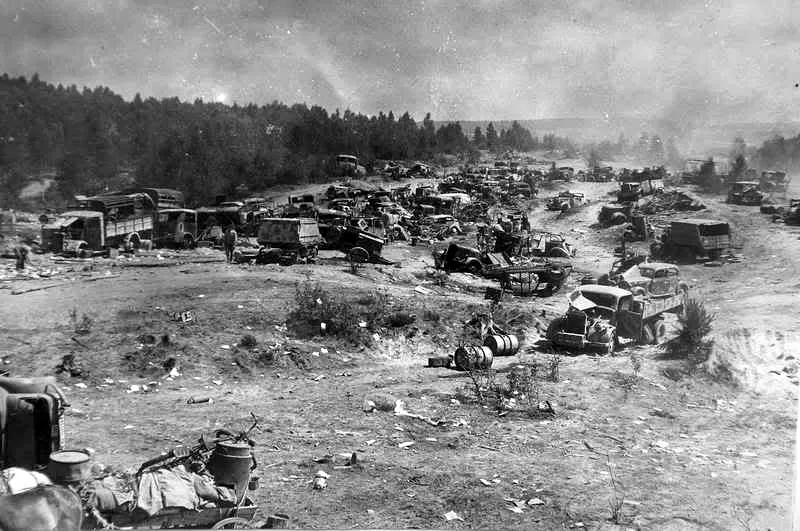
Photo: 194407 abandoned german vehicles belarus.jpg: Unknown authorUnknown author derivative work: César (talk), Public domain, via Wikimedia Commons
Somewhere in the back fields of a Wiltshire estate, partially swallowed by a blackthorn hedge and wearing thirty years of ivy like a coat, sits a Ferret scout car. The owner of the land doesn't know it's there. Or at least, that's what he told the man who knocked on his door last spring with a clipboard and a very specific look in his eye.
This is how it starts. A tip from a mate. An aerial photograph. A faded line in a 1987 MOD disposal register. And then — if you're lucky, if you've done the homework — a field, a hedge, and something extraordinary hiding underneath.
Britain's relationship with its military surplus is complicated, sprawling, and surprisingly poorly documented. Thousands of vehicles were decommissioned across the second half of the twentieth century, sold off at auction, donated to training grounds, or simply left to rot when the paperwork got too complicated. Some ended up in museums. Many more ended up nowhere in particular.
The Hunt Itself
The people who track these machines down don't advertise. They don't have websites. They operate through forums, WhatsApp groups, and the kind of mutual trust that takes years to build. Call them what you like — salvage hunters, military vehicle enthusiasts, opportunists — but the serious ones are meticulous researchers first and mechanics second.
"You're not just looking for a vehicle," explains one collector based in rural Shropshire, who asked us not to use his name. "You're building a chain of custody. Who owned it, when, what it was used for, why it ended up where it is. That chain matters legally, and it matters for the restoration."
The legal picture is genuinely murky. MOD disposal sales from the 1970s through the 1990s were often informal affairs — vehicles sold in lots, paperwork minimal, titles unclear. When a Landrover Wolf or a Humber Pig changes hands informally three or four times over three decades, establishing clean ownership becomes a serious undertaking. Solicitors who specialise in this niche exist — quietly, in market towns near former garrison sites — and they do a brisk trade.
Abandonment law adds another layer. Under English and Welsh law, a vehicle left on private land doesn't automatically become the property of the landowner, nor does it become fair game for a finder. The original owner — in many cases, technically still the Crown — retains a theoretical interest. In practice, prosecutions are extraordinarily rare, but the grey area is real, and the serious collectors know it.
What They're Actually Finding
The vehicles turning up are genuinely remarkable. Ferret scout cars are relatively common finds — lightweight, nimble, and built in such quantities that plenty slipped through the cracks of formal disposal. Saracen armoured personnel carriers appear occasionally, usually on former training estates. There are Stalwart amphibious trucks rusting in drainage ditches, half-track carriers slowly becoming part of the soil on old airfield perimeters.
More exotic still are the specialist reconnaissance buggies and lightweight utility vehicles developed for specific theatres and then quietly forgotten when those theatres closed. These are the holy grails — vehicles that exist in no official register, that show up in single photographs in regimental histories, that the collector community refers to with the kind of reverence usually reserved for vintage Ferraris.
"I found a lightweight utility frame two years ago in a barn in Northumberland," says another restorer, this one based in County Durham. "Nobody could identify it precisely for six months. We eventually traced it to a batch of twelve built for a specific signals unit in the late sixties. Two survive. Mine's one of them."
The Restoration Challenge
Finding the vehicle is, in many ways, the easy part. What follows is a restoration process that makes conventional off-road rebuilds look straightforward.
Military vehicles were built to military specifications — tolerances, materials, and fastening systems that have nothing to do with civilian supply chains. Finding correct-specification rubber seals for a 1960s scout car isn't a matter of phoning a parts supplier. It's a matter of knowing someone who knows someone who kept a stockpile when the original manufacturer closed, or who has the tooling to fabricate from scratch.
The engineering community around military vehicle restoration is tight-knit and extraordinarily skilled. Machinists who can reverse-engineer components from worn originals. Fabricators who've spent years learning the specific welding techniques used on military-grade steel. Upholsterers who know the exact canvas weight specified in period military contracts.
"Commercial restorers can't do this work profitably," says one fabricator who operates from a unit on an industrial estate outside Catterick. "The hours don't add up. The people doing it properly are doing it because they love it. Full stop."
A Community Under Pressure
The military vehicle salvage world is facing increasing pressure from several directions simultaneously. Land sales are breaking up the large estates and former training grounds where many vehicles have sat undisturbed for decades. Scrap metal prices have made farmers more likely to clear old machinery than to leave it alone. And a growing mainstream interest — fuelled partly by television programmes, partly by social media — is bringing less careful operators into a space that previously policed itself.
"The worry isn't the serious collectors," says one long-standing forum moderator. "It's the people who've watched two episodes of something on Channel 4 and think they can turn up at a farm with a trailer. They make it harder for everyone. Landowners get burned once and they're done with all of us."
The community's response has been largely to withdraw further. Fewer public posts. More private communication. A tightening of the informal vetting that determines who gets access to the good information.
For the vehicles themselves — the Ferrets in the hedgerows, the Stalwarts in the ditches — the clock is ticking regardless. Rust doesn't wait for anyone to sort out the paperwork. And every year, a few more ghosts disappear into the grass for good.