Mud on Their Terms: The Women Rewriting Britain's Buggy Scene
Kate Nicholson didn't ask for permission. She just showed up.
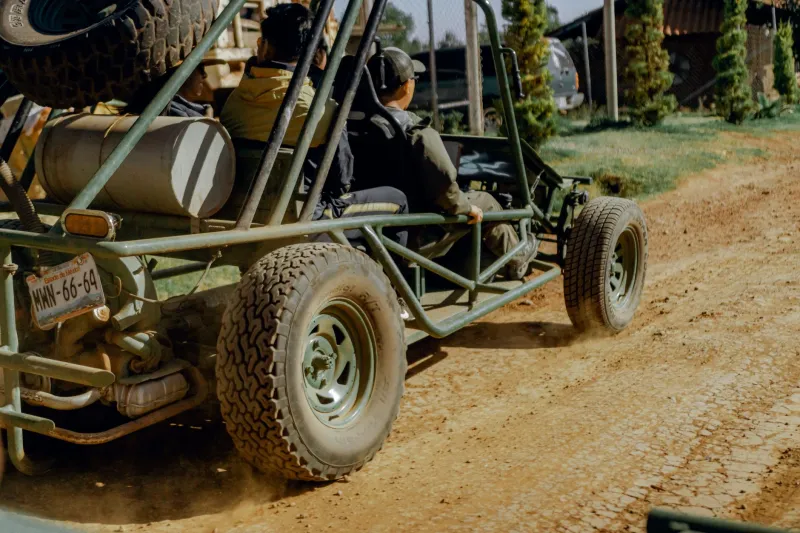
The thirty-eight-year-old agricultural engineer from Shropshire arrived at her first green lane run in 2018 driving a buggy she'd built herself in her workshop over the course of two winters. She knew the machine inside out. She knew the terrain. What she didn't fully anticipate was the quality of the welcome.
"There were a few people who were genuinely brilliant," she says. "And there were a few who clearly couldn't quite work out what to do with me. Not aggressive, just... confused. Like they weren't sure whether to explain things I already knew or just pretend I wasn't there."
Kate kept going back. And going back. Now she's one of the most respected route-planners in her regional club, her knowledge of Shropshire's green lane network is encyclopaedic, and she's helped half a dozen other women find their footing in the scene. The confusion, she says, has largely given way to respect — though she's clear-eyed about the fact that it required her to earn it in a way that most men simply don't have to.
Her experience is both specific and representative. Across Britain, women are arriving in the off-road buggy community in growing numbers — as drivers, builders, competitors, and organisers. And the scene is, gradually, adjusting to meet them.
Who's Actually Showing Up?
The demographics of the British off-road community have been shifting for a while, but the pace has accelerated noticeably in recent years. Social media has been part of the story — female off-roaders documenting their builds and adventures online have created visibility that simply didn't exist before, and that visibility has encouraged others to take the first step.
The women entering the scene come from varied backgrounds. Some, like Kate, arrive with mechanical knowledge already in place. Others come from outdoor pursuits — trail running, mountain biking, hillwalking — and find that off-road driving scratches a similar itch for physical challenge and wild terrain. A few have been introduced through partners or family members and have discovered, often to their own surprise, that they're more interested in the technical side than the person who brought them along.
Amara Osei-Bonsu, a thirty-two-year-old from Birmingham who started building her first buggy eighteen months ago, falls into the last category. "My partner had been in the scene for years and I'd come along to events but never really engaged with it," she says. "Then one day I just started asking questions about how the suspension worked and I couldn't stop. Now I'm probably more obsessed than he is."
Amara is currently finishing a tube-frame build in a shared workshop space in Wolverhampton. She documents the process on Instagram and has amassed a following that, she notes with some amusement, is predominantly male. "They seem genuinely interested in the technical stuff," she says. "The comments are mostly positive. Mostly."
The Gatekeeping Question
It would be dishonest to write about women in the buggy scene without addressing the less comfortable parts of the picture. Gatekeeping — the tendency of established community members to make newcomers feel like they haven't earned their place — is a documented feature of many motorsport and off-road communities, and it doesn't affect all newcomers equally.
Several women we spoke to described experiences that ranged from mildly patronising to actively discouraging. Unsolicited advice delivered with the assumption of ignorance. Questions about whether they'd built or bought their machine, asked in a tone that made clear what the questioner expected the answer to be. Moments at events where they felt invisible until they demonstrated competence, at which point the dynamic shifted.
"I had a man explain to me how a diff lock worked at an event last year," says Sarah Glennie, a forty-five-year-old mechanic from Inverness who has been driving off-road for over a decade. "I've been fitting diff locks since before he was probably driving on the road. I just smiled and let him finish."
Sarah is philosophical about it. "The scene is mostly good people," she says. "The ones who act like that are a minority. But they're a loud minority and they put people off, which is a shame."
The consensus among experienced female off-roaders seems to be that the gatekeeping is real but not universal, that it's improving — slowly — and that the best counter to it is simply showing up and being excellent. Which, as several of them pointed out, is an unfair additional burden that their male counterparts don't carry.
Building Your Own: The Particular Satisfaction of Making the Machine Yourself
One theme that came up repeatedly in our conversations was the specific pleasure — and empowerment — of building your own vehicle. For many of the women we spoke to, the build process was as important as the driving.
"When something goes wrong on a trail and you've built the machine yourself, you know exactly what to look at," says Kate Nicholson. "You understand it completely. That's an enormous advantage, and it also means you're not dependent on anyone else to keep your vehicle running."
The practical skills required to build a buggy — welding, fabrication, mechanical knowledge, an understanding of geometry and materials — are skills that have historically been more accessible to men, simply because of where and how they've been taught. But that's changing. Evening welding classes, online fabrication communities, and the informal mentorship networks that have grown up around the off-road scene have made these skills more accessible to anyone willing to put in the time.
Amara Osei-Bonsu learned to weld specifically to build her buggy. "I did a six-week evening course at a local college," she says. "It was mostly blokes on the course and they were all fine. Welding doesn't care who's holding the torch."
Why the Scene Needs More Female Voices
Beyond the individual stories, there's a broader argument to be made about what the off-road community gains from greater diversity. It's not a complicated argument.
More people means more perspectives, more approaches, more creativity. Some of the most innovative builds we've seen documented over the past few years have come from women who approached the engineering problems without the weight of established convention. Fresh eyes see things differently.
More women in the scene also makes the scene more welcoming to the next wave of women considering whether to get involved — a self-reinforcing cycle that benefits everyone.
"When I was starting out, I didn't know any other women who were doing this," says Sarah Glennie. "If I'd seen someone like me at an event early on, it would have made a difference. That's why I make a point of being visible now."
Kate Nicholson puts it more bluntly: "The mud doesn't know your gender. The terrain doesn't care. The only place it matters is in people's heads, and that's the bit we're working on."
She's right. And from where we're standing, the work is going well.