Throttle and Tribe: One Full Season Inside a British Off-Road Club

Photo by Photo by Thibault Lam Tran on Unsplash on Unsplash
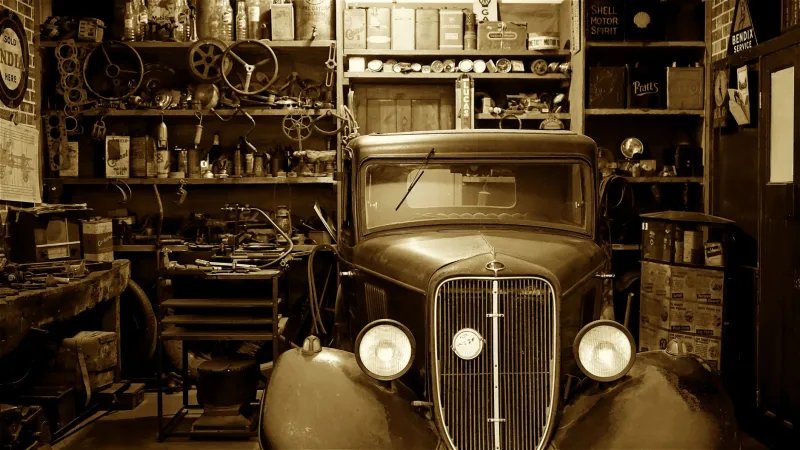
It's half past nine on a Tuesday in February, the temperature outside is three degrees, and someone has just started an argument about whether a Subaru gearbox has any business being inside a buggy built for green lanes. In a garage in Staffordshire that smells of old oil, instant coffee, and something that might be ambition, eight grown adults are gesturing at a chassis with the intensity of people who have nowhere better to be.
This is what a British off-road club actually looks like.
The Winter: When Clubs Are Really Built
Ask any long-term club member when the real season happens and they'll tell you it's not summer. It's January. It's the frozen Tuesday nights when there's no trail to ride and no glory to chase, just a broken vehicle that needs sorting and a group of people who've decided, for reasons that don't entirely hold up to rational scrutiny, to sort it together.
The Midlands Dirt Collective — not their real name, they asked for a degree of anonymity that lasted approximately four minutes before someone mentioned their actual club name in conversation — has been running for eleven years. They have 23 members on the books, of whom roughly fourteen can be described as active, and of those, about eight show up reliably for winter build nights.
Those eight represent a cross-section of British life that no diversity consultant could have engineered. There's a retired HGV driver named Geoff who builds buggies from memory and mild contempt for instruction manuals. There's a 26-year-old apprentice electrician, Callum, who documents everything on his phone and has more YouTube subscribers than anyone else in the group, a fact that Geoff finds both baffling and faintly irritating. There's a secondary school teacher, a semi-retired farmer, a woman named Carol who arrived three years ago knowing nothing about off-road vehicles and is now widely regarded as the most mechanically competent person in the building.
"The thing about winter nights," Carol explains, not looking up from a differential she's inspecting with a torch, "is that you can't fake it. In summer, you can coast on enthusiasm and good weather. In January, you either know what you're doing or you ask someone who does. That's when you actually learn."
The Unwritten Rules
Every club has them. Nobody writes them down because writing them down would require acknowledging they exist, and acknowledging they exist would require a committee meeting, and committee meetings are how clubs die.
Rule one: if you break something on a trail day, you tell someone immediately. Not because anyone will judge you — breakdowns are a matter of when, not if — but because the recovery operation is part of the day, and everyone wants to be part of it.
Rule two: opinions about other people's vehicle choices are permitted, but only up to a point. The point is usually defined by whether the vehicle in question is actually working. A Defender with a lift kit and 33-inch tyres is fair game for gentle ribbing. A Defender that just pulled your buggy out of a ditch is temporarily above criticism.
Rule three, and this is the one that surprises outsiders most: nobody cares what you drive to the trail day. The Porsche Cayenne and the 15-year-old Berlingo exist in the car park without hierarchy. Status inside the club is determined entirely by what happens once the gates close.
The Great Modification Debate
If there is a single argument that never fully resolves itself across the course of a season, it is the question of vehicle purity. On one side: the traditionalists, who believe that a good off-road vehicle is one that started life as an off-road vehicle and has been maintained and modified with its original character in mind. On the other: the builders, who regard any donor vehicle as raw material and any drivetrain as a legitimate option if it does the job.
The flashpoint this particular season was Callum's buggy — a tube-frame build on a Suzuki SJ chassis, running a turbocharged Hayabusa motorcycle engine. It was, by any objective measure, terrifyingly fast and technically brilliant. It was also, in Geoff's view, "a motorcycle that's had a bad dream."
The argument that followed, across three separate Tuesday nights, covered everything from the philosophy of off-road vehicle design to the ethics of using a donor vehicle that nobody's driven on road in twenty years. It was, in the end, completely unresolved. Callum's buggy ran flawlessly on the next trail day. Geoff admitted it was "tidy, for what it is." This was understood by everyone present to be a significant concession.
Summer: The Season That Tests Everything
By May, the talk shifts from build nights to bookings. Trail days need to be arranged, permissions confirmed, route sheets printed. The club secretary — a role that rotates annually and is accepted with the enthusiasm of someone being handed a parking fine — coordinates logistics with the cheerful resignation of a person who knew exactly what they were signing up for.
The summer trail days have their own rhythm. Early start, coffee from a flask, a briefing that covers the route, the recovery protocol, and a reminder that the landowner's gates are to be closed behind every vehicle, every time, without exception. Then the gate opens and the day begins.
What happens on those days is difficult to describe to someone who hasn't been part of it. There are moments of genuine skill — a perfectly judged line through a waterlogged descent, a recovery that takes four people and twenty minutes and ends in laughter. There are moments of genuine chaos. There is, almost always, a moment somewhere in the middle of the afternoon where everything pauses — vehicles stopped on a hillside, engines ticking, views stretching away to somewhere improbable — and the group exists briefly in a kind of collective silence that has nothing to do with conversation.
The day ends at a pub. Not always the same pub, but always a pub. This is non-negotiable.
What Clubs Are Actually For
Ask the members of the Midlands Dirt Collective why they do this and you'll get eleven different answers. The vehicles. The terrain. The challenge. The craic. The excuse to spend Tuesday evenings in a warm-ish garage rather than watching television.
What you won't get, at least not directly, is the honest answer, which is visible in the way Geoff checks in on Callum's progress without being asked to, or in the way Carol ended up being the person who drove an hour to help a member she'd met twice sort out a broken diff the weekend before a trail day.
British off-road clubs aren't really about the vehicles. The vehicles are just the reason people showed up in the first place. What keeps them coming back is something older and less complicated than any of them would probably admit to in a cold garage on a Tuesday night.